Microsoft
Microsoft is the most fully covered platform in this playbook, and the one where the data foundation and the AI stack are most tightly joined: Fabric and OneLake hold the data, Foundry serves the models and hosts the agents, and Purview and Content Safety govern both. The pages below break that stack down component by component.
Recommended Architecture
The reference architecture for a Microsoft-based AI build. It reads left to right - source systems land through ingestion and OCR, move through a medallion data foundation on Fabric backed by OneLake, feed the AI foundation (retrieval, models, agents), and surface through an integration layer into reporting and assistants.
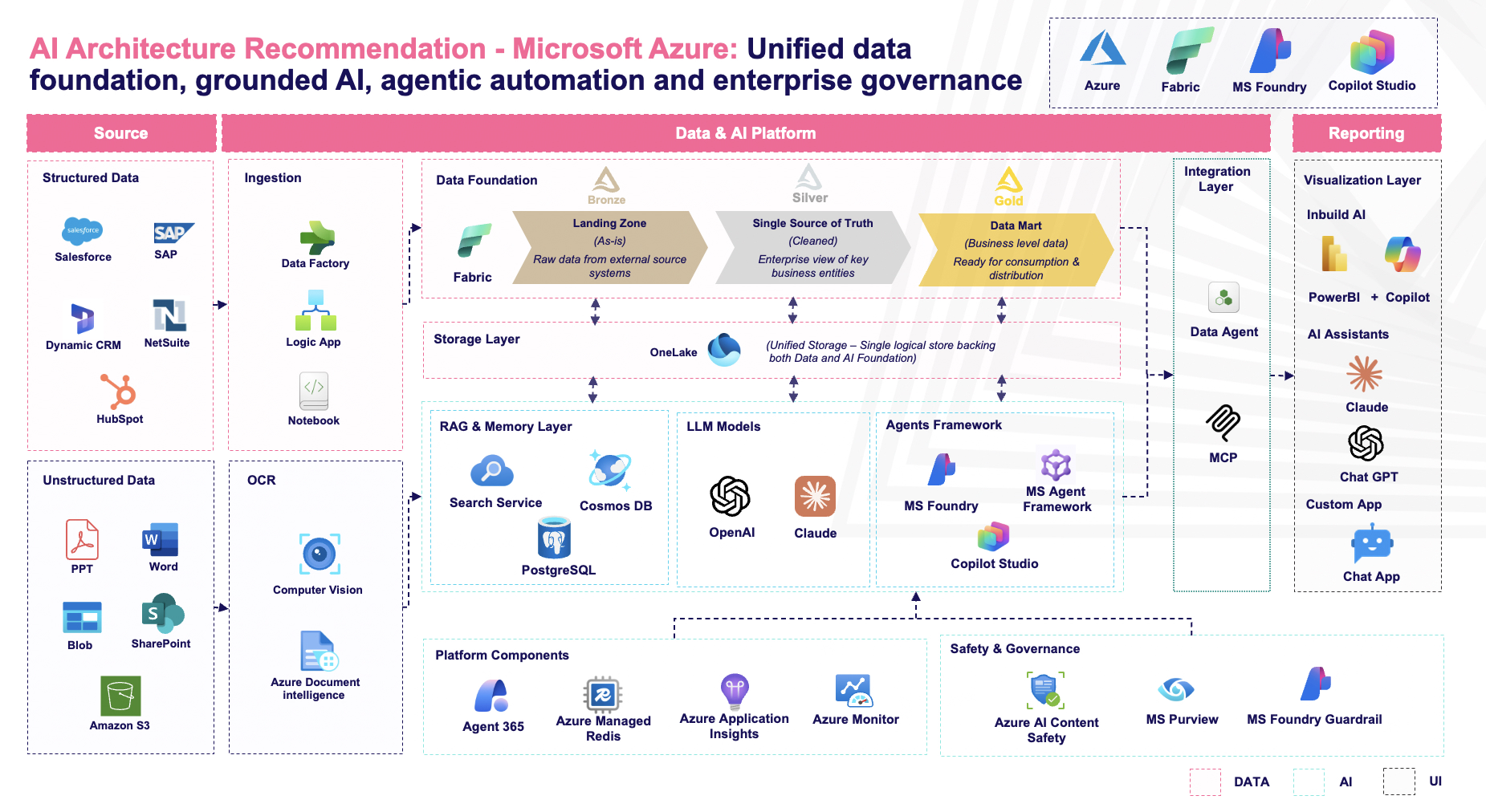
The colour legend on the diagram separates the three concerns it spans: DATA (pink), AI (blue), and UI (dashed). Four things in it are worth calling out because they are the parts most often left until too late:
- OneLake as a single logical store. The Data Foundation and the AI Foundation read the same storage rather than the AI layer working from a copy. That is what keeps retrieval grounded in the same numbers the dashboards report.
- OCR as a first-class ingestion path. Computer Vision and Azure Document Intelligence sit alongside Data Factory and Logic Apps, not bolted on later. Unstructured sources (PPT, Word, SharePoint, Blob, S3) enter through their own lane. See OCR + Document Processing.
- Platform Components and Safety & Governance are drawn as their own tiers. Agent 365, Managed Redis, Application Insights, and Azure Monitor on one side; Content Safety, Purview, and Foundry Guardrail on the other. Both wrap the whole platform rather than attaching to one service.
- The Integration Layer (Data Agent and MCP) is the seam. It is what lets the reporting and assistant layer reach governed data and tools through one contract instead of point-to-point wiring. See MCP.
For the narrower agentic view of this same platform, and the equivalent diagrams for Databricks, Snowflake, AWS, and Google Cloud, see Target Architectures.
Start Here
- Microsoft AI Platform - the four ways to build on Microsoft (Foundry, Agent Framework, Copilot Studio, Fabric) and how to choose between them.
Foundry
- Microsoft Foundry - the production AI platform: model access, managed agent hosting, knowledge retrieval, observability, and governance.
- Foundry Models - model catalogue, deployment types, fine-tuning, and cost.
- Foundry Agent Service - prompt agents, hosted agents, and memory.
- Foundry IQ - the enterprise knowledge layer: retrieval, grounding, and knowledge bases.
- Foundry Tools - pre-built Speech, Vision, Language, and Document Intelligence capabilities.
Building Agents
- Microsoft Agent Framework - the pro-code SDK for agents, harnesses, and workflows (AutoGen plus Semantic Kernel).
- Copilot Studio - the low-code SaaS agent platform: build visually, deploy to Teams and M365.
Data and Retrieval
- Microsoft Fabric - the unified data platform with built-in AI: OneLake, Eventhouse, Data Agent.
- AI Search - vector search, hybrid retrieval, and semantic ranking: the retrieval engine behind most Azure RAG builds.
Operating in Production
- Observability & Evaluation - tracing, evaluation, and ROI measurement.
- GenAI API Gateway - API Management as a GenAI gateway: load balancing and PTU overflow.
- Security & Guardrails - threats, Azure-native mitigations, Content Safety, and agent controls.