AI Play Book
We seamlessly combine PE experience, strategic thinking, and Data & AI capabilities across due diligence, strategy, governance, AI delivery, and automation to turn commercial data into actionable insights and enhanced business outcomes.
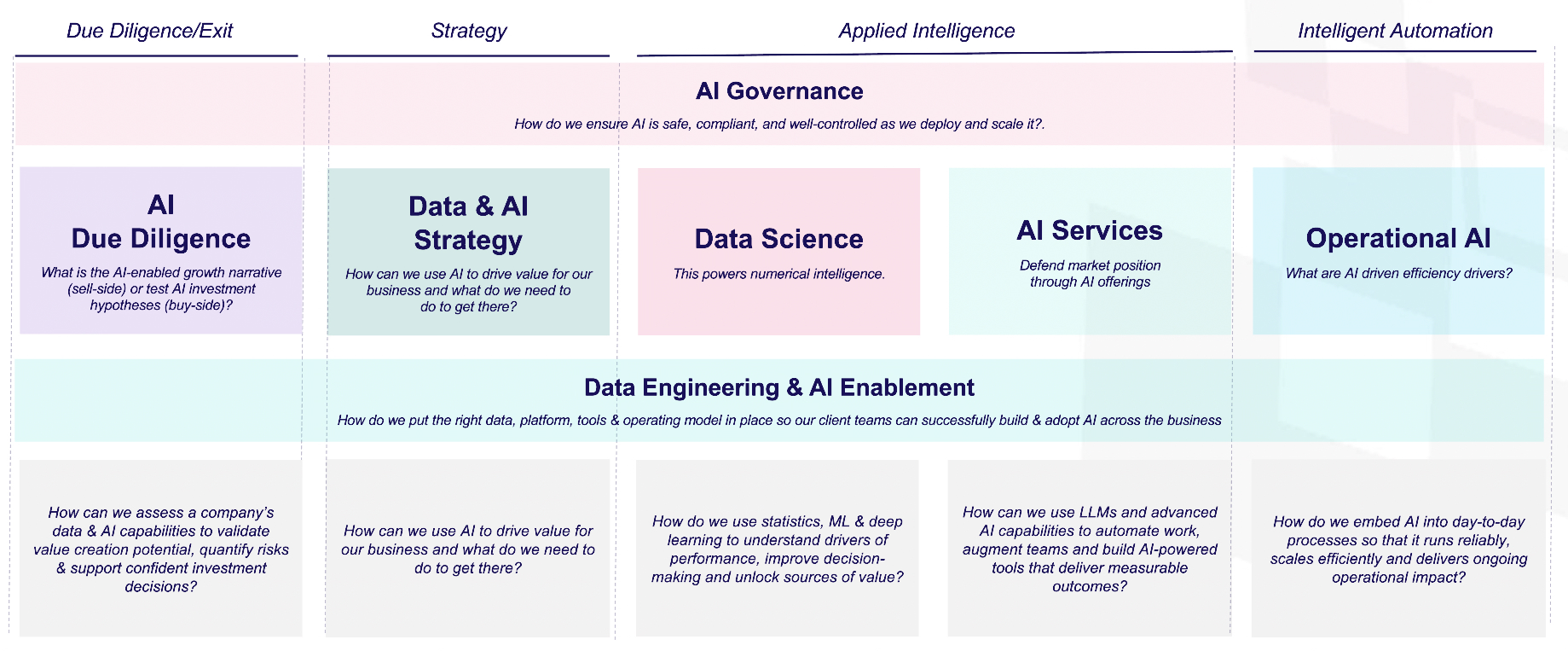
This playbook is designed for technical and commercial teams involved in shaping, designing, and delivering AI solutions. It provides a common understanding of AI concepts, solution patterns, platforms, implementation considerations, and decision criteria that can be applied across client engagements. Technical teams can use it to guide architecture and delivery decisions, while commercial teams can use it to understand AI capabilities, identify suitable opportunities, and support informed client conversations. The goal is to establish a shared AI language and consistent baseline for solution quality, security, governance, and responsible AI across the organisation.
How AI, Machine Learning, and Generative AI Nest
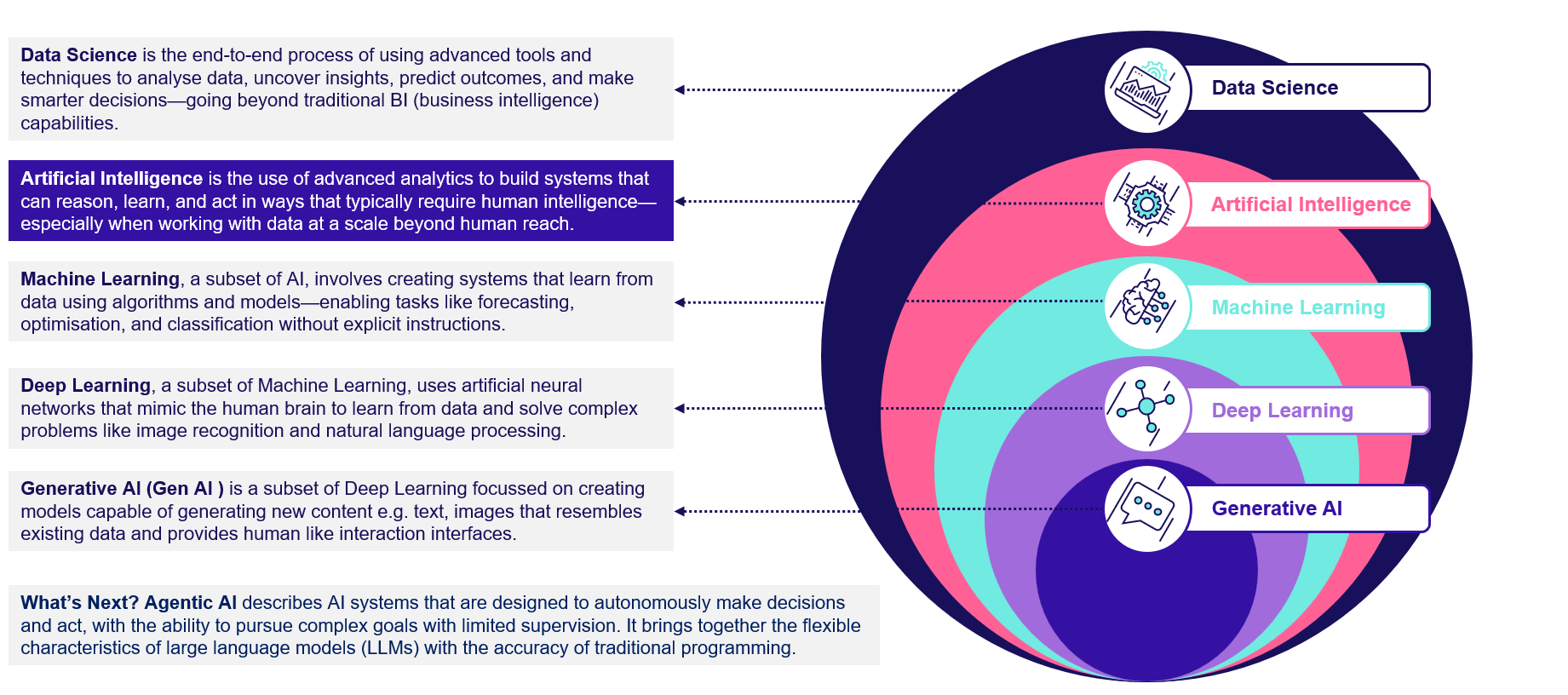
Each layer is a subset of the one outside it. That containment is where most scoping confusion starts: a deterministic rules engine is automation rather than AI, and "AI" is not a synonym for "LLM". AI Fundamentals works through the distinction in full.
Our AI Philosophy: Build On Foundations, Don't Replace Them
AI builds on existing data foundations rather than substituting for them, but the dependency is not uniform. Anything that answers questions about governed business numbers - a predictive model, conversational BI, intelligent query - is only as good as the data platform underneath it, so it waits on the foundation. Generative and autonomous solutions that work over documents, emails, contracts, and inbound events are not restricted that way: enrichment, classification, extraction, and workflow automation can be delivered independently. Strong foundations make those solutions better, not possible.
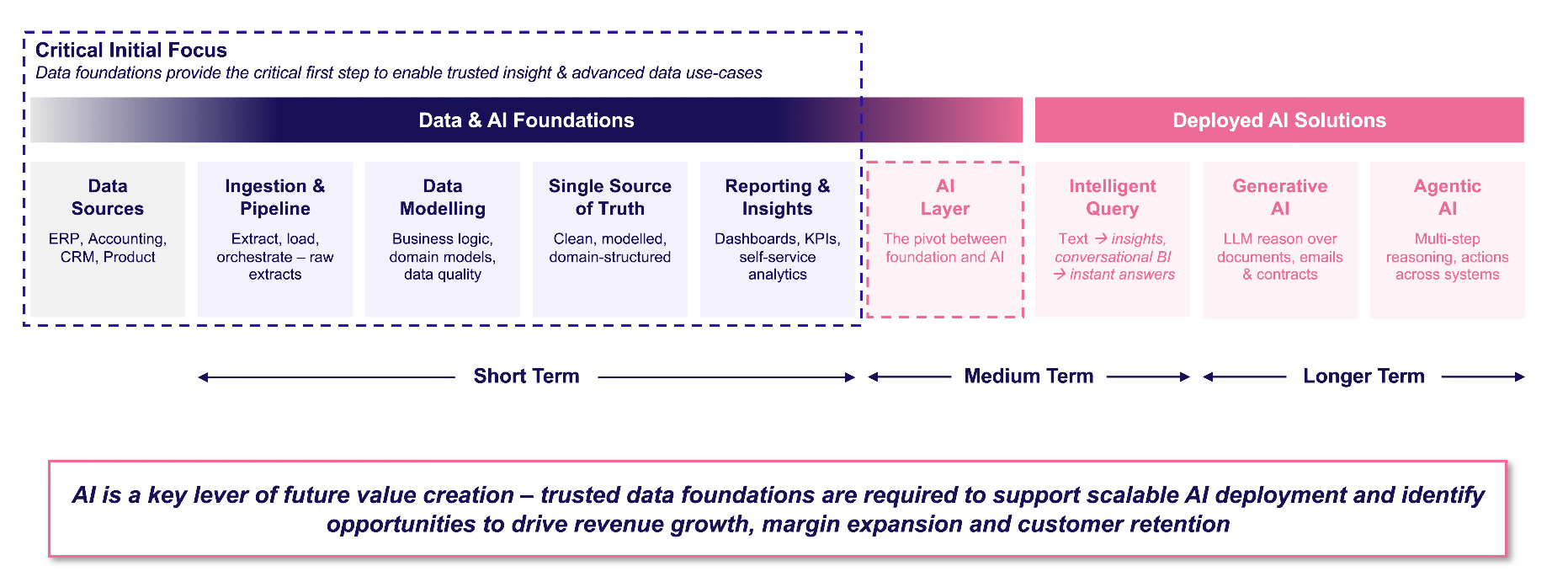
The AI Layer is the pivot. Everything to its left is foundation work - sources, ingestion, modelling, a single source of truth, and the reporting layer on top of it. Everything to its right is deployed AI. The horizons are the practical read: foundations and reporting are short-term work, intelligent query becomes reachable once the semantic layer is trustworthy, and agentic automation across systems is a longer-term commitment rather than a starting point. The three mechanisms - data science, generative AI, and autonomous AI - are covered in depth in the Fundamentals and Architecture sections below.
How to Use This Playbook
This first release covers the foundations: the vocabulary, reference architecture, and platform guidance every later section assumes. Use-case scoping, delivery process, engineering standards, evaluation, case studies, and governance are planned for later releases. Where you start depends on why you opened it.
New to AI
Read in order. The first two sections are the language everything else is written in, and skipping them makes the rest harder than it needs to be.
- AI Fundamentals - what AI, ML, and generative AI actually mean, and the three mechanisms used to classify any use case.
- AI Terminology - the glossary. Read the simplified column and the car analogy first.
- AI Architecture - skim it. Come back when a project needs one of the patterns.
Engineers and Architects
You know the concepts. Go straight to the detail and treat the first two sections as reference.
- AI Terminology deep dives - sampling parameters, context management, prompt structure, tool definitions, memory patterns, groundedness measurement.
- AI Architecture - RAG, agents, multi-agent orchestration, MCP, fine-tuning, guardrails, and how they compose.
- Platforms - what is built in per platform, and Target Architectures for the end-state designs.
Consultants and Delivery Leads
You need to scope and defend a recommendation, not build it.
- AI Fundamentals - the three mechanisms for classifying a use case, and the honest benefits, limitations, and misconceptions for client conversations.
- AI Terminology - the simplified explanation and business relevance columns give you the language without the implementation detail.
- Platform Comparison - side-by-side capability and cost assessment behind a platform recommendation.
Playbook Sections
Expand a section to see what it covers, or open the full page.